
Early Signs of Disc Problems Most People Ignore Until It’s Too Late
Are you ignoring minor lower back stiffness or occasional leg numbness? Discover the early markers of spinal disc compression before they evolve into debilitating structural injuries.

A significant majority of patients who walk into a clinic presenting with severe, debilitating sciatic neuralgias or advanced disc prolapses almost always begin their medical history with the exact same sentence: "I had this mild, dull ache for months, but I just assumed it would go away on its own."
This article is written specifically for individuals who are currently standing in that exact intermediate phase. It is for the corporate professionals navigating long commutes across Hyderabad's financial hubs, the long-distance drivers, and the active individuals who are currently managing, coping, adjusting, and popping occasional over-the-counter painkillers—all while ignoring the subtle, progressive warning signs their spine is transmitting.
Disc issues rarely manifest as a sudden, catastrophic injury without a history of minor warnings. More often, they are the result of cumulative micro-strain. Understanding these early signals can mean the difference between a simple, conservative recovery and an invasive, long-term structural intervention.
Part 1: The Subtle Signs Nobody Takes Seriously
In its initial stages, spinal disc stress does not scream; it whispers. Because human beings are remarkably adaptable, we quickly learn to normalize low-grade physical discomfort, categorizing structural red flags as simple "fatigue" or "muscle tightness."
If you notice any of the following five symptoms recurring in your weekly routine, your intervertebral discs are likely under mechanical duress.
1. Lower Back Stiffness After Extended Sitting
You sit at your office desk or in your car for two hours. When you finally stand up, you cannot instantly straighten your spine. You find yourself hunched forward slightly for the first few steps, waiting for your lower back to "unlock."
This is not simple muscle fatigue. When you sit, the mechanical load on your lumbar discs increases by up to 150% compared to standing. This sustained pressure forces fluid out of the disc core. The stiffness you feel is the direct result of a temporarily dehydrated, compressed disc struggling to re-absorb fluid and adjust to an upright, weight-bearing posture.

2. An Occasional, Transient Leg Numbness or Tingling
You might feel a brief, faint "pins and needles" sensation traveling down your thigh, settling in your calf, or creeping across the top of your foot. It doesn’t necessarily hurt; it just feels like your leg is briefly "falling asleep." It usually disappears if you shift your weight or walk around.
This transient numbness is an explicit indicator that a bulging disc is physically encroaching upon a spinal nerve root. The sensation comes and goes because the disc profile changes throughout the day based on your posture and spinal loading patterns.
3. Morning Tightness That Disappears After Initial Movement
Waking up with a stiff, unyielding lower back that requires a hot shower or 15 minutes of moving around to feel normal is a classic early marker of disc degeneration.
During sleep, your spinal discs naturally undergo a process called imbibition—they act like dry sponges, soaking up surrounding fluids and expanding to reset their height. If a disc's outer wall is compromised or under chronic strain, this fluid influx increases internal pressure significantly overnight. The morning tightness you experience is the sensation of an over-pressurized, vulnerable disc stretching an already inflamed outer ring.
4. A Deep, Dull Ache That Slowly Shifts Locations
Unlike acute muscular spasms that feel sharp and localized to a specific muscle group, early disc stress presents as a deep, poorly localized ache. One week it feels like a tight glute muscle; the next week it shifts to the upper buttock, or feels like a deep ache inside the pelvic bone.
This shifting pattern occurs because the sensory nerves innervating the outer layers of the disc (the sinuvertebral nerves) project vague pain signals across broader neurological segments.
5. Postural Relief Dynamics (The Sitting-vs-Walking Test)
If your back discomfort consistently worsens while sitting, driving, or bending forward to pick up an object, but feels remarkably better when you are walking at a moderate pace, you are dealing with a disc-dominant mechanical pattern. Forward flexion pushes the soft inner gel of your disc backward toward your spinal canal, while walking restores natural spinal curves and takes the direct compressive load off the disc center.
Part 2: The Psychology of Delay: Why Patients Keep Waiting
If the spine is actively sending warning signals, why do so many people wait until they cannot walk before seeking professional help? The delay is rarely due to a lack of awareness; rather, it stems from a series of highly common psychological and behavioral traps.
- The "Fluctuating Pain" Trap: Because early disc stress is heavily tied to daily body mechanics, pain is rarely linear. A patient might experience three days of nagging discomfort followed by four days of complete normalcy. This cyclical pattern tricks the mind into believing that whatever was wrong has spontaneously healed itself. In reality, the tissue is slowly losing structural resilience during each silent phase.
- The Chemical Masking Effect: Over-the-counter non-steroidal anti-inflammatory drugs (NSAIDs) or muscle relaxants are highly accessible. While they are effective at blocking pain pathways and down-regulating acute inflammation, they create a false sense of security. By artificially removing the pain boundary, patients continue to subject their spine to the exact daily habits (like heavy lifting or poor ergonomics) that caused the micro-tears in the first place.
- The Business of Daily Life: In a fast-paced professional environment, taking time out for a clinical spine evaluation is frequently pushed down the priority list. It is easy to classify spinal health as an issue for "later," operating under the assumption that serious medical problems happen suddenly, rather than progressing slowly behind the scenes.
Part 3: What Actually Happens Inside Your Spine?
To understand why a minor ache can transform into an overnight emergency, we must examine the internal anatomy of the spine without complex medical jargon.
Your spine is built like a precision suspension system. Each bony vertebra is separated by an intervertebral disc that functions simultaneously as a heavy-duty shock absorber and a flexible pivot point.
A healthy disc consists of two primary components:
- The Annulus Fibrosus: A tough, multi-layered outer ring made of interlocking collagen fibers. Its job is to contain the inner core and manage rotational and bending forces.
- The Nucleus Pulposus: A highly hydrated, spherical gel core sitting directly in the center. It handles vertical weight-bearing forces, distributing load evenly across the entire spine.
The Breakdown Sequence: From Strain to Bulge
When your spine is subjected to chronic, repetitive strain—such as slumping over a laptop, sitting with a rounded lower back, or lifting objects using your spine instead of your hips—the alignment shifts. The vertical weight distribution fails.
The vertical load forces the soft, gel-like inner core backward, pressing it directly against the structural outer rings. Under this constant pressure, the outer collagen fibers experience micro-tears.
Initially, these micro-tears occur in the deep inner layers of the ring, which completely lack pain receptors. This means the structural damage is actively progressing inside your spine without causing any noticeable pain.
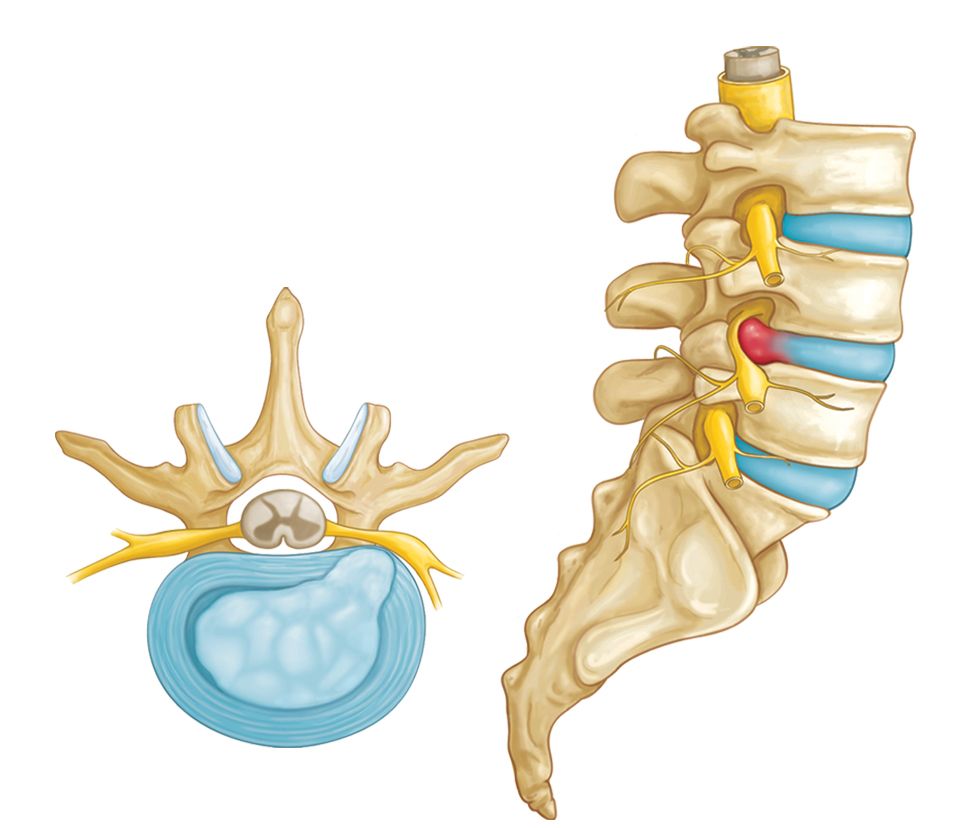
As the micro-tears extend outward to the final, highly sensitive layers of the outer ring, your body triggers an inflammatory response to heal the area. This is when the early warning signs appear: the deep dull ache, the morning stiffness, and the localized tightness.
If this structural warning is ignored, a minor trigger—such as sneezing, bending down to tie a shoe, or lifting a grocery bag—can create enough intra-discal pressure to cause the inner gel to break completely through the final outer layer. This is a disc herniation, which can directly compress the adjacent sciatic nerve root and cause intense, radiating leg pain.
Part 4: Why Early Intervention Changes Everything: The Vedansha Approach
The operational gap between a "manageable" disc problem and a "serious" clinical emergency is significantly smaller than most people think. It is not a matter of months or years; it is a strict structural threshold. Finding a specialized Marma therapy practitioner in Hyderabad during this intermediate phase changes the entire recovery trajectory.
When you seek clinical support during this early stage—while the outer ring is strained but fully intact—our treatment protocol avoids heavy traction or masking medications. Instead, we use a targeted, step-by-step Ayurvedic path to restore structural balance:
- Decompressing Nerve Gateways via Marma Chikitsa: Instead of applying forceful external mechanics, we use precise digital activation on key nerve-receptive hubs like Kati Marma, Kukundara Marma, and Nitamba Marma. This specialized neural stimulation safely down-regulates nerve excitability and creates a therapeutic window of decompression around vulnerable nerve roots.
- Releasing the Body's "Protective Muscle Splint": Chronic structural strain causes localized surrounding back muscles to tighten into a painful spasm to guard the spine. Targeted Marma activation sends immediate bio-feedback to the nervous system, signaling these deep defense layers to relax, restoring lost micro-circulation to the area.
- Restoring Natural Disc Hydration (Imbibition): Once the guarding muscles release, we employ gentle, localized manual soft-tissue mobilization by marma therapy massage. This precise application improves tissue elasticity, reduces structural dryness, and relieves spatial compression, allowing the dehydrated disc core to naturally re-absorb fluid and expand.
- Correcting Core Stability & Movement Tracking: True recovery extends past the clinical table. We teach you simple, highly specific movement patterns to reactivate the deep stabilizers of your spine (like the multifidus and transversus abdominis), shielding your healing disc from gravity during your everyday routine.
Once a disc undergoes a significant mechanical tear or structural herniation, the recovery journey becomes fundamentally more complex. While non-surgical options are still highly effective, the treatment timeline lengthens considerably, requiring extensive rehabilitation, strict activity modifications, and a significantly higher investment of time and energy.

A Note Before You Close This Page
If you found yourself recognizing a specific symptom while reading this article, or remembering a structural warning sign you have been continuously explaining away as simple stress, that realization is highly valuable.
Spinal disc degeneration is completely manageable, but it does not resolve spontaneously if your daily mechanical habits remain unchanged. Your body provides explicit warnings long before a crisis occurs; the outcome depends entirely on whether you choose to listen to them.
Taking action early is never an overreaction. Investing in a proper clinical assessment today is the most definitive way to ensure your spine remains stable, moving, and pain-free for years to come.
Disclaimer: This article is for informational purposes only and does not constitute formal medical advice. Please consult a qualified healthcare professional for precise clinical evaluation and treatment mapping.
Experiencing Chronic Back Stiffness or Occasional Leg Discomfort?
Do not wait for a minor structural warning to turn into a painful clinical emergency. Schedule a precise, non-invasive spinal alignment and mechanical assessment in Hyderabad today to protect your long-term mobility.
Book Consultation